
Brand, Performance, or AI: Where Should Your Next Marketing Dollar Go?
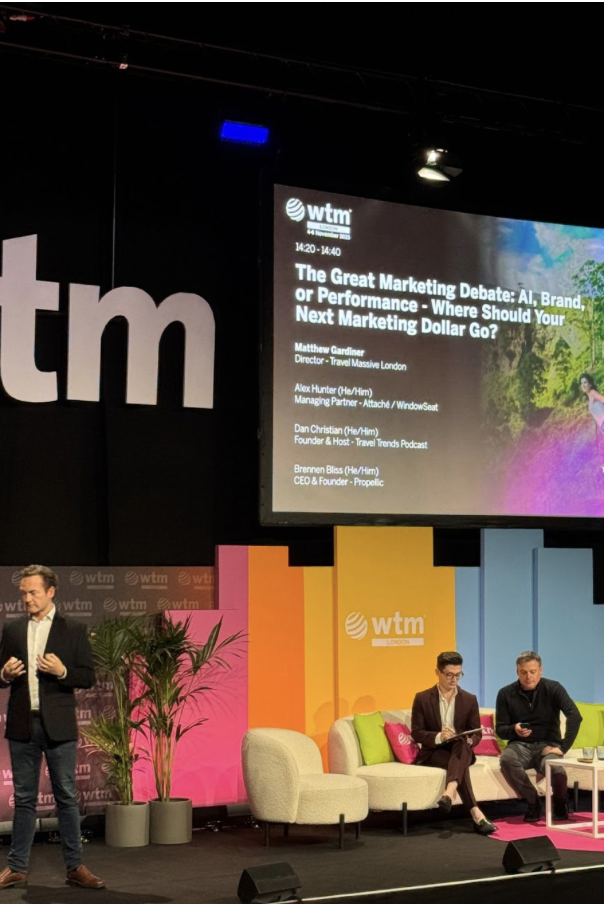
At World Travel Market 2025, three marketing leaders took the stage for a spirited debate moderated by Matthew Gardiner, Director of Travel Massive London. The debate cut to the heart of every CMO's dilemma: where do you invest your next marketing pound? Alex Hunter (Managing Partner at Attaché and WindowSeat), Brennen Bliss (CEO and Founder of Propellic), and Dan Christian (Founder and Host of Travel Trends Podcast) each championed different approaches: brand, performance, and AI marketing respectively. Whilst framed as a battle between these three strategies, the discussion revealed far more nuanced truths about how successful travel companies are navigating an increasingly complex marketing landscape.
The Case for Brand: Feeling Trumps Price
Alex Hunter opened with a powerful premise that resonates with anyone who's ever booked a trip based on emotion rather than spreadsheet analysis. "We have spent a long time focusing on price and performance," Hunter argued. "We compete on cost, we compete on value, and we're really good at that. But that's not necessarily how we as human beings make our purchasing choices."
His challenge to the audience was visceral: think about that trip of a lifetime you took, perhaps 25 years ago. You can recall the smell, the sounds, the extraordinary moments in vivid detail. But can you remember what it cost? Absolutely not, because the price doesn't persist. The feeling does.
This insight strikes at the fundamental truth of travel marketing. When someone steps off the aeroplane at a destination you've sold them on and takes that first breath of air, when they walk into your hotel for the first time or the hundredth time, how are they going to feel? That emotional connection is what drives repeat bookings and brand loyalty.
Hunter's argument wasn't about dismissing performance marketing entirely. Rather, it was about recognising that competing solely on price and efficiency leaves money on the table. "Where we will see not just incremental value but revolutionary value is when we communicate that feeling powerfully."
His position became even clearer when challenged to choose between the other two options. Looking at post pandemic success stories, Hunter pointed to Airbnb's hardcore focus on brand. "You can't succeed with performance marketing alone. You end up just spending all your money on performance marketing, the costs keep going up, the returns keep going down. There's just so much competition. You need to be successful at brand. That's something you can own."
The Case for Performance: Measurable, Agile, Foundational
Brennen Bliss from Propellic, who manages nearly $100 million in ad spend across 60 travel brands, made three core arguments for performance marketing: it's measurable and provable, it's agile, and it serves as the foundation for everything else.
"The CMO is going to come and ask what is working," Bliss explained. "That's not the same question as what's creative, what's exciting, what's clever. It's what's driving bookings. It's not just about the thing that feels good. It's the thing that you can measure."
His second argument centered on agility, something particularly crucial in travel's volatile environment. Weather, current events, and rapid market shifts demand marketing that can pivot quickly. "You can stop guessing," Bliss argued. "On the second to last day of the month, we unlocked an extra 200 grand in client budget to make sure the month closed well, because it will set us up operationally to not lose money in six months."
Performance marketing allows you to react in real time. If tours are at 90% capacity and getting them to 100% means the difference between profit and loss, performance marketing can deliver that last push immediately. Brand campaigns, whilst powerful, take months to develop and deploy.
Perhaps most importantly, Bliss positioned performance marketing as the funding engine. "Performance is not the enemy of brand. Brand is not the enemy of performance. But it is the funding engine. Performance as a core is typically the first thing I look at when building a marketing infrastructure because it's going to be the thing that pays for the important brand work."
His pragmatic view acknowledges that both matter, but in his experience, you need the immediate returns from performance to fund longer term brand building. "I like performance because it pays for brand, not because it's better than brand. Brand feeds performance and vice versa."
The Case for AI: The Bridge and the Multiplier
Dan Christian from Travel Trends Podcast presented the AI argument not as a replacement for brand or performance, but as a transformative force that enhances both whilst offering unique advantages.
Christian opened with a provocative premise: "You've already invested in brand and performance. You've been having this debate with yourself for the last 10 years or more. Any other dollar you have to spend right now, you should be spending on AI."

The argument rested on three pillars. First, AI is the only investment that can reduce costs rather than simply requiring more spend. "It's all about efficiency gains, and that's more money you can invest in marketing. The first opportunity when investing in AI is to reduce costs through efficiency."
Second, AI serves as a force multiplier through automation at scale, predictive insights, and hyper-personalisation that neither traditional brand nor performance marketing can match alone. Christian cited a compelling example from the AI Summit: Jean-Philippe Duchesneau Co-Owner at Groupe Écorécréocreated an entire tourism business in 30 minutes, complete with brand, website, marketing campaign, and even a Quebec rap song. "That used to take 6 to 12 months and involve multiple agencies and stakeholders. That is the power of these tools."
Third, and perhaps most controversially, the claim that AI outperforms traditional performance marketing. "Anyone who's done a LinkedIn campaign recently has two options: manual or automated. We did both for the AI Summit. Which performed better? AI changed creative, messaging, and optimised goals every time."
Christian's closing argument framed AI as essential infrastructure rather than just another channel: "The smartest dollar isn't spent on a campaign. It's spent building the intelligence that will power every campaign to come."
The Cross Examination
The most illuminating moments came when the panellists questioned each other directly.
When Hunter challenged Bliss to choose between brand and AI if he had to invest 100% of his budget in one, Bliss admitted: "We do some brand marketing, but it certainly isn't much." However, he turned the question back: "How do you work with feedback? With performance marketing, we can test something in a day and know if it worked. What tools do you use?"

Hunter's response revealed the challenge and opportunity of brand marketing: "There has to be a clear understanding of who you are and what you're trying to get people to experience. Then you have to be open to all of the structured feedback coming through every single possible channel. It's not always going to sound good, but if what you think you're saying and what people are hearing don't match up, you've got a major problem."
The measurement challenge is real. Brand marketing doesn't offer the same day one clarity as performance. But Hunter argued it provides something equally valuable: "A very clear understanding of how you're perceived in the world. You have to be open to the possibility that what you're saying is not what's being heard."
When Bliss challenged Christian about successful AI use cases, the response highlighted a crucial emerging reality: AI driven search is fundamentally changing how travellers research and book. "There's a substantial portion of travellers researching through ChatGPT and AI mode. If we know how to show up in Google search, what do we do when people aren't necessarily using the same channels to discover and purchase travel?"
Christian's example was a large vacation rental platform experiencing declining organic traffic (a familiar pain point for many in the room). The solution involved rethinking content for AI processing: structuring information in chunks rather than full pages, focusing on co-occurrence (how frequently you're mentioned alongside your topic across the internet), and optimising for how AI surfaces information rather than traditional SEO.
The Uncomfortable Truth
Of course, the debate's framing was somewhat artificial, as the moderator acknowledged. "The truth in marketing is that marketing is at its best when it is a mix, each channel feeding the other to deliver the best results."
Yet the exercise forced clarity on strategic priorities. If you had an extra hundred thousand pounds tomorrow, where would it go? If you're fighting for budget in Q4, what's your strongest argument?
The most successful travel companies referenced in the debate (Booking.com, Expedia, Airbnb) didn't choose one approach. They mastered the interplay. Booking.com built its empire on ruthlessly efficient performance marketing but had to develop brand capability to become truly global and enter the US market successfully. Expedia travelled the opposite journey, starting with brand and having to master performance to compete.
Both ultimately succeeded because they figured out how to excel at both, not because they chose one over the other.

Where to Place Your Bet
For travel marketers facing this decision in 2026, several principles emerge from the debate:
Start with performance if you're building from scratch. It provides the measurable returns and immediate feedback loops needed to fund growth and prove marketing's value to the business.
Invest in brand when you have foundation and competition is driving up performance costs. Brand creates differentiation and pricing power that pure performance marketing cannot deliver. It's what you own when the algorithms change.
Explore AI as infrastructure, not just another channel. The companies gaining advantage aren't just using AI for content creation or ad optimisation. They're rethinking how their entire marketing operation functions, from customer research through to post booking engagement.
Measure brand even if it's uncomfortable. The feedback may be messy and unstructured, but understanding perception gaps is as valuable as knowing your cost per acquisition.
Remember that feelings drive decisions, even in B2B travel. The business traveller choosing between hotel chains and the family planning their holiday aren't running spreadsheet analyses. They're imagining how they'll feel.
The debate format forced false choices for dramatic effect. The reality is more nuanced but no less strategic. The question isn't which one matters, but rather which one do you need to strengthen right now given where your business sits and where your market is heading?
In 2026, that might just be all three simultaneously, but in different proportions than you're currently deploying.
This article draws insights from the World Travel Market 2025 marketing debate moderated by Matthew Gardiner (Travel Massive London), featuring Alex Hunter (Attaché/WindowSeat), Brennen Bliss (Propellic), and Dan Christian (Travel Trends Podcast).